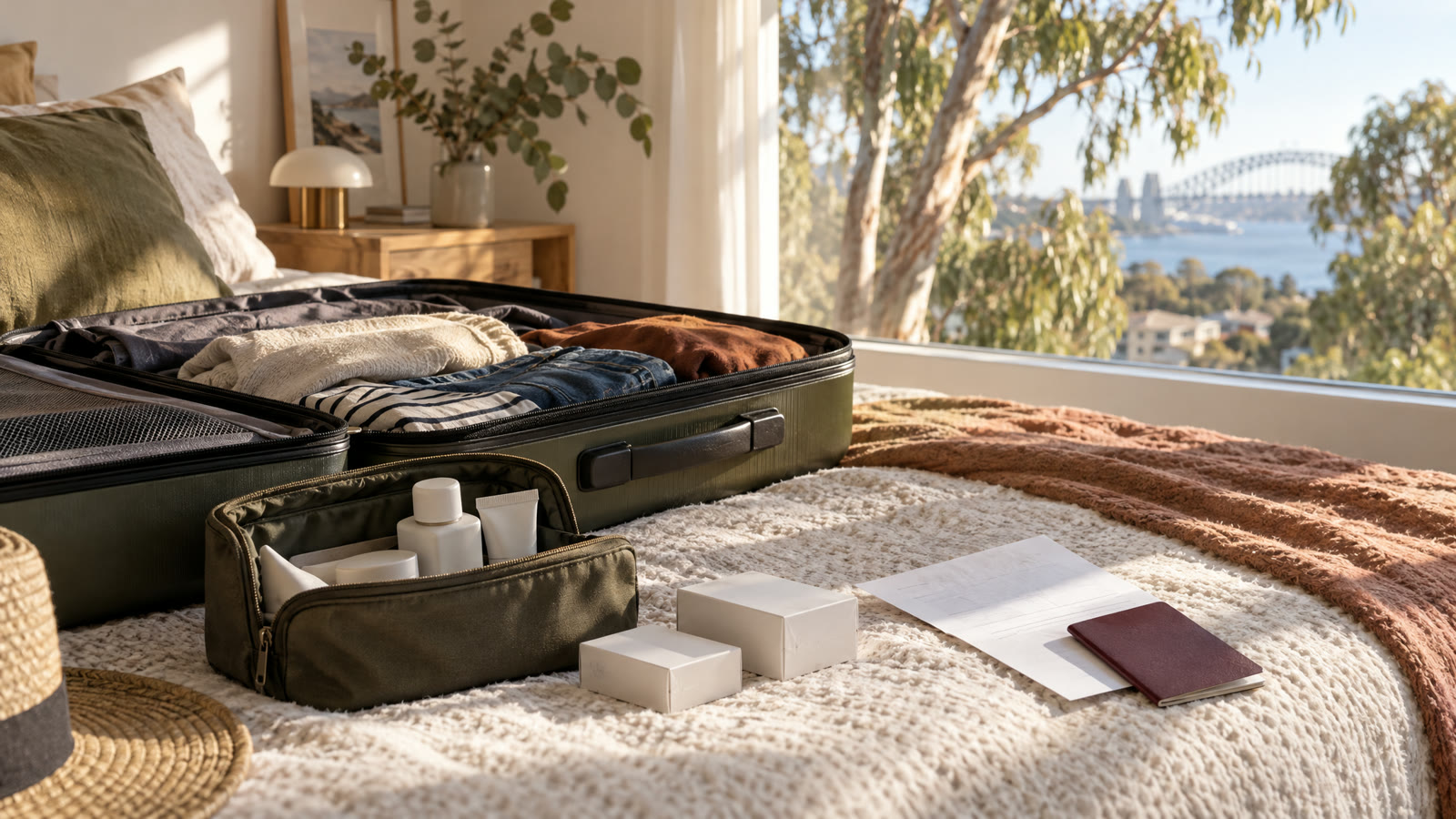
Yes, you can bring your prescription medication from Ireland into Australia. Under the traveller’s exemption you can carry up to 3 months’ supply for your own use, as long as it is in your luggage with you, you have a prescription or doctor’s letter in English, and you declare it when you land. That covers most things, including ADHD medication and benzodiazepines, but a handful of medicines are banned without a permit and posting more over later has completely different rules.
Rules below are as of November 2026, from the Therapeutic Goods Administration (TGA), the Office of Drug Control (ODC) and the Australian Border Force (ABF).
Short version
- Bring no more than 3 months’ supply, for you or an immediate family member travelling with you.
- Carry it in your accompanied baggage, in the original packaging with the pharmacy label on.
- Bring your prescription or a letter from your GP, written in English, saying what the medicine is and how much you are carrying.
- Declare it to the Australian Border Force when you arrive.
- Codeine needs a prescription or letter, whatever the strength. A few substances (like mifepristone) need written permission from the Office of Drug Control.
- Staying longer than 3 months? See an Australian GP for an Australian prescription. Medicine posted from Ireland is not covered by the traveller’s exemption.
The traveller’s exemption: what you can bring
The traveller’s exemption is the rule that lets you bring medicines and medical devices into Australia for personal use without asking anyone for permission first. According to the Office of Drug Control, it allows you to bring:
- up to 3 months’ supply of medicine for personal use
- medicines for an immediate family member travelling with you (for example, a child travelling with a parent)
- medical devices, such as blood glucose monitors.
The TGA gives examples of everyday medicines covered: tablets for cholesterol, blood pressure, blood glucose and stomach acid, the contraceptive pill, antibiotics, blood glucose monitoring devices and sleeping tablets.
Crucially, it also covers prescription medicines containing controlled substances. The ODC names morphine, oxycodone, methadone, methylphenidate and benzodiazepines, and the ABF adds Adderall to that list. So if you are on Ritalin, Concerta or a benzo, you do not need a permit to bring it in for yourself, provided you follow the conditions below.
Three months is three months, by the way. Not “three months plus a few spare boxes because Mam was worried”. The limit is the limit, however convincing she was in the kitchen.
The conditions you have to meet
The ABF says prescription medication can come in under the traveller’s exemption provided that:
- you are arriving in Australia as a passenger on a ship or aircraft
- the medicine is in your accompanied baggage (it travels with you, not shipped separately)
- you carry a letter or copy of your prescription, written in English, from your doctor certifying that the medicine was prescribed to you for a medical condition
- the quantity is no more than 3 months’ supply.
On top of that, the TGA’s rules for the exemption say:
- do not bring medicine for anyone other than yourself or an immediate family member travelling with you
- do not sell or supply it to anyone else
- keep it in its original packaging with the dispensing label, if possible, so it can be identified
- take any leftover medicine with you when you leave Australia
- follow requests and directions from customs officers.
It is against the law to bring medicines into Australia to give to someone else. So when your mate in Bondi asks you to “bring over a few boxes” of something, the answer is no, even if they are buying the first round.
What to ask your GP for before you go
The simplest approach is to book a visit with your GP a few weeks before you fly and ask for a letter that names each medicine, the strength, the dose and how much you are carrying. The ODC says the prescription or letter must identify the medicine you have been prescribed. Bring the paper prescription or a copy too if you can. Keep both in your hand luggage, not in the suitcase that may or may not turn up in Perth.
Tip: If you use a weekly pill organiser or a Webster pack from your pharmacy, the ODC recommends keeping medicine in the original packaging instead. If you must use a dose pack, carry paperwork that clearly identifies each medicine and confirms it was prescribed for you.
Declaring your medicine when you land
Both the ODC and the ABF say to be ready to declare your medicine to the Australian Border Force when you arrive. Medicine for personal use is listed by the ABF as a “declare it” item. Declaring does not mean it will be taken off you. It means an officer may want to look at it and your paperwork, which is exactly why the original box and the GP letter matter.
The officers have seen everything, from insulin coolers to a suitcase that is 60% Barry’s Tea. Tick the box, show the letter, and you will be on your way to the taxi queue.
Codeine and other medicines that catch Irish people out
Codeine
The ODC is clear: you need a prescription or letter from your doctor to bring medicine containing codeine into Australia, regardless of its strength, and you must meet the other traveller’s exemption conditions too. If you normally keep codeine painkillers in your washbag, either leave them at home or bring a letter that covers them.
Medicines you cannot bring under the exemption
Some substances are not covered at all, and need written permission from the Office of Drug Control. The ODC and ABF list:
- abortifacients, such as mifepristone (RU486)
- yohimbe (yohimbine)
- aminophenazone, amidopyrine, aminopyrine, dipyrone and metamizole
- amygdalin or laetrile (sometimes sold as “vitamin B17”).
If you rely on one of these, speak to an Australian health professional about other treatment options before you travel.
Medicinal cannabis
You can bring up to 3 months’ supply of prescribed medicinal cannabis under the traveller’s exemption, but you must have a valid prescription from your doctor. The ODC says a cannabis card, dispensary note or similar document is not a substitute for a prescription. No prescription, do not bring it.
Herbal remedies and anything from animals or plants
The TGA says to keep herbal and traditional medicines in their original packaging so the ABF can identify them. Products made from endangered plants (including Hoodia weight loss products) need a permit. Medicines containing biological, animal or plant material may also face biosecurity checks, so check the Department of Agriculture’s BICON system before you pack them.
Staying longer than 3 months
Most people reading this are staying a year or two, so 3 months will not stretch. You have two options.
Option 1: get an Australian prescription (the easy one)
The ODC says that if you run out, or will run out, you can see an Australian registered prescriber, such as a GP, and if appropriate they can give you an Australian prescription to fill at an Australian pharmacy. Bring your Irish letter and the empty box to that first appointment. It saves a lot of “the small white one, you know the one”.
Be aware of what the Ireland agreement covers. Under the Reciprocal Health Care Agreement, people who were living in Ireland before arriving can get some PBS (Pharmaceutical Benefits Scheme) prescription medicines at the general rate, and you ask the pharmacy to treat you under the agreement and show your Irish passport. As of November 2026 the PBS general patient co-payment is AUD 25.00 per script. But the agreement does not cover GP visits: Services Australia says you will not get a Medicare benefit for out of hospital services. And if you are on a student visa, you are not covered by Medicare at all. We explain the rest in our Medicare guide for Irish people.
That GP visit gap is one reason to have proper cover. True Traveller offers cover for working holiday makers, and our travel insurance for Australia guide covers what to look for. Check any policy’s wording on pre-existing conditions before you buy.
Option 2: have it posted from overseas (harder than it sounds)
Medicine posted to Australia is not covered by the traveller’s exemption. It falls under the TGA’s Personal Importation Scheme, which has stricter conditions:
- If the medicine is prescription-only in Australia, you must hold a valid Australian prescription at the time it is imported. Your Irish prescription is not enough.
- Each import can be no more than 3 months’ supply, and no more than 15 months’ supply in any 12 month period.
- It must be for you or an immediate family member, in original or clearly identifiable packaging.
- It must not contain a controlled substance. That rules out posting things like ADHD medication or benzodiazepines under this scheme.
- Electronic prescriptions (eScripts) are not accepted as the written authority for importing.
The TGA advises sending the seller (or whoever is posting it) a copy of the paper Australian prescription to include in the package, and only ordering what the doctor prescribed. If the import does not match the prescription, it can be seized, and the TGA says it cannot arrange partial releases.
The TGA also warns that counterfeit medicines bought online are seized even if you have a prescription. For most people, Option 1 is simpler.
Tip: If your medicine is not sold in Australia at all, the ABF says to contact the Drug Control Section at [email protected] for instructions, and the TGA says an Australian doctor can apply through the Special Access Scheme if you need more than a 3 month supply in one go.
Flying: hand luggage, needles and stopovers
The ODC does not regulate airline baggage rules, so check with your airline about carrying liquids, injectables, syringes, needles or auto-injectors in the cabin. It also suggests keeping essential medicines with you in case your checked bag is delayed or lost. The TGA’s own example is an insulin user who brought it on board in a small cooler, in the original packaging, with the prescription and a doctor’s letter.
There are no direct flights from Ireland to Australia, so you will change planes somewhere on the way. The ODC says to check the requirements of any countries you transit through, as some have strict rules on prescription medicines, particularly narcotic medicines and medicinal cannabis. Contact that country’s embassy or consulate before you fly if you are carrying anything controlled. Twenty-something hours in economy is punishment enough without a chat in an airport office in Doha.
Going home to Ireland with medication
Flying home? The ODC says to carry your prescription or a doctor’s letter, keep medicine in its original packaging, and check the rules of your destination and any stopover country. The ODC cannot issue official documents confirming you are allowed to carry a medicine, so if a country asks for that, follow the advice on Smartraveller. Moving back for good? Our moving back to Ireland guide covers the rest of the list.
Your medication checklist
| Before you fly | Why |
|---|---|
| GP letter in English naming each medicine and amount | Required by the ABF for the traveller’s exemption |
| No more than 3 months’ supply | The exemption limit |
| Original boxes with pharmacy labels | So border officers can identify it |
| Medicine in your carry-on | In case checked bags go missing |
| Check codeine and the banned list | Codeine needs paperwork; some substances need an ODC permit |
| Check stopover country rules | Transit countries have their own laws |
| Declare it on arrival | Medicine is a “declare it” item |
| Book an Australian GP before month 3 | You will need an Australian prescription to keep going |
For everything else to sort before you go, see our moving to Australia checklist and the complete guide to moving to Australia from Ireland.
Not sure which GP or pharmacy to try when you land? Ask in your local Irish group. Someone will have been through it in the same suburb last month.
FAQ
Can I bring prescription medication into Australia from Ireland?
Yes. Under the traveller’s exemption you can bring up to 3 months’ supply for personal use in your accompanied baggage, with a prescription or doctor’s letter in English, and declare it on arrival.
How much medication can I take to Australia?
No more than 3 months’ supply. For more than that in one go, an Australian-registered doctor would need to apply to the TGA’s Special Access Scheme.
Do I need a doctor’s letter to bring medicine into Australia?
For prescription medicines, yes: the ABF says to carry a letter or copy of your prescription, written in English, certifying that the medicine was prescribed to you.
Can I bring ADHD medication into Australia?
Yes, up to 3 months’ supply under the traveller’s exemption. The ODC and ABF name methylphenidate and Adderall as covered. You cannot have controlled medicines posted to you under the Personal Importation Scheme.
Can I bring codeine into Australia?
Only with a prescription or doctor’s letter, regardless of the strength, and within the other traveller’s exemption conditions.
Do I have to declare medication at Australian customs?
Yes. The ABF lists medicine for personal use as an item to declare. Keep it in the original packaging so officers can identify it.
Can my family post my medication from Ireland?
Only under the Personal Importation Scheme: for prescription-only medicines you need a valid Australian prescription at the time it arrives, no more than 3 months’ supply per import, and no controlled substances.
Does Medicare cover prescriptions for Irish people?
Under the Reciprocal Health Care Agreement, people who lived in Ireland before arriving can get some PBS medicines at the general rate (AUD 25.00 per script as of November 2026). GP visits are not covered, and student visa holders are not eligible.