Bushfire season in Australia depends on where you are. The Bureau of Meteorology puts peak fire danger in northern Australia from June to November, across the middle of the country from mid-October to mid-January, and in southern Australia from December to February. Fires can start at any time of year though, so the habit to build is checking the fire danger rating and your state’s warning app before you head anywhere near the bush.
Coming from Ireland, none of this is second nature, and that’s grand. This guide covers the season, the warnings, the apps, fire bans, and what to do on the road, in a rental or in the smoke. Everything here is from official sources, as of November 2026.
Short version
- Download your state’s emergency app on day one and set a watch zone for where you live and work.
- Check the Fire Danger Rating every day over summer, especially before a road trip. On a Catastrophic day, stay out of bushfire risk areas.
- Learn the three warning levels: Advice, Watch and Act, Emergency Warning. If you see fire near you, don’t wait for a warning.
- On a total fire ban day: no campfires, no wood or charcoal barbecues. Gas barbecue rules differ by state.
- Driving through the bush? Tell someone your route, carry water and a wool blanket, and turn back if you see smoke ahead.
- In an emergency, call Triple Zero (000).
When is bushfire season in Australia?
The Bureau of Meteorology says Australia’s fire weather season lasts most of the year. Each state also sets its own legal fire season, when restrictions apply and burning needs a permit.
| Where | When fire danger peaks or restrictions apply |
|---|---|
| Northern Australia | June to November, through the dry season (Bureau of Meteorology). |
| Central latitudes | Mid-October to mid-January (Bureau of Meteorology). |
| Southern Australia | December to February (Bureau of Meteorology). |
| Queensland | Starts in the far north in July and can run to February in the south (Queensland Government). |
| New South Wales | Bush Fire Danger Period: 1 October to 31 March, varied locally (NSW RFS). |
| Victoria | Set council by council. For 2026/27, East Gippsland started 5 October 2026, many country areas start in November, and dates run to 1 May 2027 (CFA). |
| South Australia | 2026/27 season: from 15 October 2026 in districts like Flinders and the West Coast, from 1 December 2026 in Adelaide, ending 15 or 30 April 2027 (CFS). |
WA, Tasmania and the NT set their own periods too, so check your local fire service.
Bushfire season 2026: what the official outlooks say
The Seasonal Bushfire Outlook for Spring 2026, published by the Australasian Fire and Emergency Service Authorities Council (AFAC) on 19 August 2026, flagged heightened fire risk across northern and south-eastern NSW, south-east Queensland, north-eastern Tasmania, parts of WA, South Australia and Victoria, and large parts of the NT.
AFAC publishes an outlook every quarter, and the summer 2026/27 edition wasn’t out when we checked on 17 November 2026. Watch the AFAC outlook page. AFAC stresses its outlook doesn’t predict where fires will happen, and dangerous fires can break out in areas with a normal outlook.
The Bureau’s long-range forecast issued 12 November 2026 says December to February daytime temperatures are very likely to be above average across most of Australia, and its 10 November update says a strong to very strong El Niño is underway. In plain English: expect a hot summer and keep that app switched on.
Bushfire in Australia today: where to check live fires and warnings
To see whether there’s a bushfire near you right now, go straight to the official source for your state.
| State | Official app or website |
|---|---|
| New South Wales | Hazards Near Me NSW app (formerly Fires Near Me) and the NSW RFS Fires Near Me map. Bush Fire Information Line: 1800 679 737. |
| Victoria | VicEmergency app and emergency.vic.gov.au. VicEmergency Hotline: 1800 226 226. |
| Queensland | Queensland Fire Department current bushfires and warnings. |
| Western Australia | Emergency WA app and emergency.wa.gov.au. |
| South Australia | Alert SA app and the CFS warnings page. CFS Information Hotline: 1800 362 361. |
| Tasmania | TasALERT and the Tasmania Fire Service. Information Line: 1800 000 699. |
| Northern Territory | SecureNT fire incident map (NT Fire and Rescue Service and Bushfires NT). |
| ACT | ACT Emergency Services Agency incidents map and the Hazards Near Me app. ABC Local Radio: 666 AM. |
| Anywhere | ABC Emergency map and your local ABC radio station. |
Since 1 October 2026, AusAlert also pushes alerts to phones near an emergency. No sign-up, app or Australian SIM needed, though phones made before 2019 may not receive them.
The warning levels: Advice, Watch and Act, Emergency Warning
Bushfire warnings use the national Australian Warning System:
| Warning level | What it means and what to do |
|---|---|
| Advice (yellow) | A fire has started but there’s no immediate danger. Stay up to date in case things change. |
| Watch and Act (orange) | The threat is rising. Start taking action now, which can mean getting ready to leave, or leaving now if you’re not prepared. |
| Emergency Warning (red) | The highest level. You may be in danger and need to act immediately. Any delay puts your life at risk. |
If a fire starts near you, the official guidance is to act immediately and not wait for a warning.
Fire Danger Ratings: Moderate, High, Extreme, Catastrophic
A warning is about a fire that’s already burning. A Fire Danger Rating tells you how dangerous a fire would be if one started. In NSW, ratings and total fire bans are set each afternoon for the next day.
| Fire Danger Rating | What it means and what to do |
|---|---|
| No Rating | No action needed. Fires can still happen but aren’t likely to threaten the community. |
| Moderate | Plan and prepare. Most fires can be controlled. |
| High | Be ready to act. Decide what you’ll do if a fire starts. The safest option is to avoid bushfire risk areas. |
| Extreme | Take action now. Fires will spread quickly. If you’re not fully prepared, go somewhere safer well before a fire arrives, and reconsider travel through risk areas. |
| Catastrophic | For your survival, leave bushfire risk areas, early in the morning or the night before. Homes can’t withstand fires in these conditions. |
Total fire bans: what you can and can’t do
The NSW RFS sums up a total fire ban as no fires out in the open. In the five states below, campfires and wood or charcoal barbecues are out, and gas or electric barbecues come with conditions:
- NSW: gas is OK with an adult present, 2 metres clear, water on hand, and within 20 metres of a home or in an approved picnic area.
- Victoria: gas or electric with 3 metres clear, 10 litres of water or a hose ready, and an adult present (CFA).
- South Australia: gas or electric within 15 metres of a home or business, or on a coastal foreshore, with 4 metres clear and an extinguisher (CFS).
- WA: gas with an enclosed flame, at home or in an authorised area like a public park, 5 metres clear (DFES).
- Tasmania: electric or LPG only, 1 metre clear, supervised (TFS).
National parks can be stricter. In NSW parks, visitor-owned gas and electric barbecues are generally banned on total fire ban days, and parks can be closed when fire risk is high.
The fines are serious. In NSW, lighting a fire during a ban is an on-the-spot fine of AUD 2,200, or up to AUD 5,500 and/or 12 months in jail in court, rising to AUD 132,000 and/or 14 years if it escapes and causes damage. In WA it’s an AUD 1,000 infringement, or up to AUD 25,000 and/or 12 months in jail on conviction, and that includes flicking a lit cigarette out a car window.
Travelling, campervans and regional work
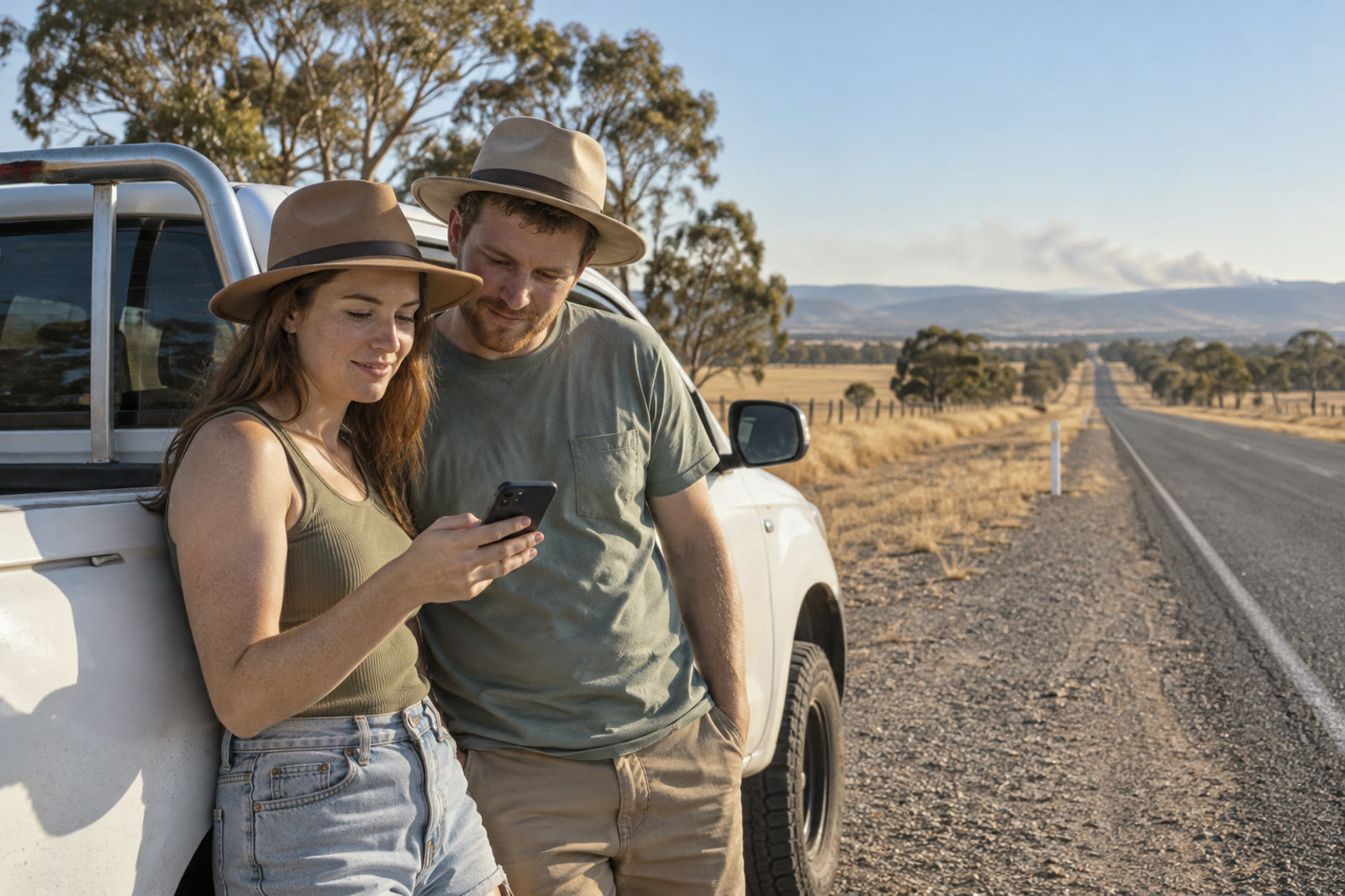
This is where Irish newcomers are most exposed: regional work and your 88 days, national park road trips, or a campervan relocation across the country. The NSW RFS warns that fires often cross roads, and roads can close without warning.
- Check the Fire Danger Rating for where you are, where you’re going and the stretch between, and set watch zones in your app.
- Don’t drive through remote areas on a total fire ban day (NSW RFS). Never travel to or through high risk areas on a Catastrophic day, and avoid them on Extreme days (CFA).
- Tell someone where you’re going, and check park closures, such as NSW park alerts or Queensland park alerts.
- Pack water, woollen blankets, protective clothing and a battery radio, as your phone may not work in remote areas. Download the Emergency+ app, which helps a 000 call taker find you.
On a farm, ask your boss about the fire plan on day one. The NSW RFS has a free online course, Bushfire Safety for Workers. In WA, councils can issue Harvest and Vehicle Movement Bans that stop harvesting and other off-road work.
If you’re caught in a fire on the road
The Queensland Government says turn around and drive to safety if you can, and the CFA says don’t drive through smoke. If there’s no way out, the advice on sheltering in a car is:
- Park off the road in a clear area, away from trees and long grass, facing the fire.
- Turn on your headlights and hazard lights.
- Close the windows and air vents.
- Get down below the windows under a dry woollen blanket.
- Drink water and stay down until the fire front passes. The car will be hot.
The states differ on the engine: NSW and Victoria say turn it off, Queensland says leave it running, so read the advice for the state you’re in. Before a big trip, sort your travel insurance for Australia. On a working holiday, True Traveller is the one we point people to, but check what the policy says about natural disasters.
Renting in a bushfire-prone area: make a simple plan
If your house share backs onto bush, make a bushfire survival plan. The NSW RFS says it takes about five minutes at myfireplan.com.au. Cover four things:
- What makes you leave, like a Catastrophic rating or a Watch and Act for your area. Leaving early is the safest option.
- Where you’ll go, and your route plus a backup.
- What you’ll bring: passport, phone charger, medication, water.
- Your last resort if you can’t leave, such as a Neighbourhood Safer Place in NSW.
Each state has a template: NSW, Victoria, Queensland, WA, South Australia, Tasmania, ACT and the NT. Also, Moneysmart says renters need their own contents insurance, because the landlord’s policy covers the building, not your stuff.
Smoke and your health
Smoke travels a long way. Check live air quality, for example NSW air quality or EPA Victoria’s AirWatch. On smoky days, NSW health advice is to stay indoors more, close windows and doors, and put the air conditioner on recirculate. If you can’t avoid the smoke, a well-fitted P2 or N95 mask helps. Surgical and cloth masks don’t.
If you have asthma, healthdirect says use your preventer, keep your reliever puffer with you and follow your asthma action plan. Call healthdirect on 1800 022 222 for advice, or 000 for trouble breathing or chest pain.
How to help, the right way
Give money through official channels, such as the NSW RFS and Brigades Donations Fund or your state fire service’s own appeal. The NSW RFS alone has more than 70,000 volunteers. On a working holiday visa? Home Affairs says voluntary recovery work in declared bushfire areas can count as specified work for a second or third visa.
The Irish bit: set yourself up on day one
Add this to your moving to Australia checklist, right beside learning the beach flags and rips:
- Download your state’s emergency app the day you land.
- Save 000. From a mobile, 112 reaches the same service.
- Show your family at home the ABC Emergency map, and agree you’ll text them whenever a fire near you makes the news.
- In a major emergency, the Red Cross may switch on Register.Find.Reunite, where you can register as safe and family can search for you.
- Register with the Department of Foreign Affairs through Citizens Registration, so the embassy can reach you in a crisis.
Starting farm work or planning a road trip? Ask in your local Irish group. Someone has done that drive before and will tell you what fire season is really like there.
FAQ
When is bushfire season in Australia?
The Bureau of Meteorology puts peak fire danger at June to November in the north, mid-October to mid-January across the middle of the country and December to February in the south. Bushfires can still happen at any time of year.
Is the 2026 bushfire season expected to be bad?
AFAC’s Spring 2026 outlook flagged heightened risk in parts of every mainland state, and the Bureau expects a hotter than average summer across most of Australia. AFAC’s summer outlook wasn’t out as of 17 November 2026.
How do I check for a bushfire in Australia today?
Use your state’s official app or website, like Hazards Near Me in NSW or VicEmergency in Victoria, or the ABC Emergency map for the whole country.
What’s the difference between a fire danger rating and a warning?
A rating tells you how dangerous a fire would be if one started that day. A warning is about a fire that’s already burning.
Can I have a barbecue on a total fire ban day?
In NSW, Victoria, SA, WA and Tasmania, not with wood, charcoal or heat beads. Gas or electric is allowed under strict conditions that differ by state, and national parks can be stricter.
Should I travel on a Catastrophic fire danger day?
Not into or through bushfire risk areas. Leave them the night before or early in the morning.
Will I get emergency alerts on my Irish phone?
You may. AusAlert doesn’t need an Australian SIM or an app, but phones made before 2019 may miss it, so download your state app as well.
How can my family in Ireland know I’m safe?
Text them first. In a major emergency the Red Cross may switch on Register.Find.Reunite, where you can register as safe.