
Australian slang is mostly ordinary English with the end chopped off and an “o” or “ie” stuck on, plus a handful of phrases that sound like one thing and mean another. “Bring a plate” means bring food, “smoko” is a break at work, and if someone offers to shout you a coffee, they’re paying. Below is our full Aussie-Irish translator: 29 everyday phrases, what they mean, and what we’d say back home.
Most of it you’ll pick up in a fortnight. The rest you’ll learn the hard way, usually at a barbie, holding an empty plate.
Short version
- “How ya going?” is just hello. “Good thanks, you?” is the whole answer.
- “Bring a plate” means bring a plate of food to share. Never an empty plate.
- Smoko is a short break at work, and you don’t have to smoke to take it.
- If someone shouts you a coffee, they’re paying. “My shout” means my turn to pay, like “my round” at home.
- “Yeah, nah” is usually a polite no, a bit like our own “I will, yeah”.
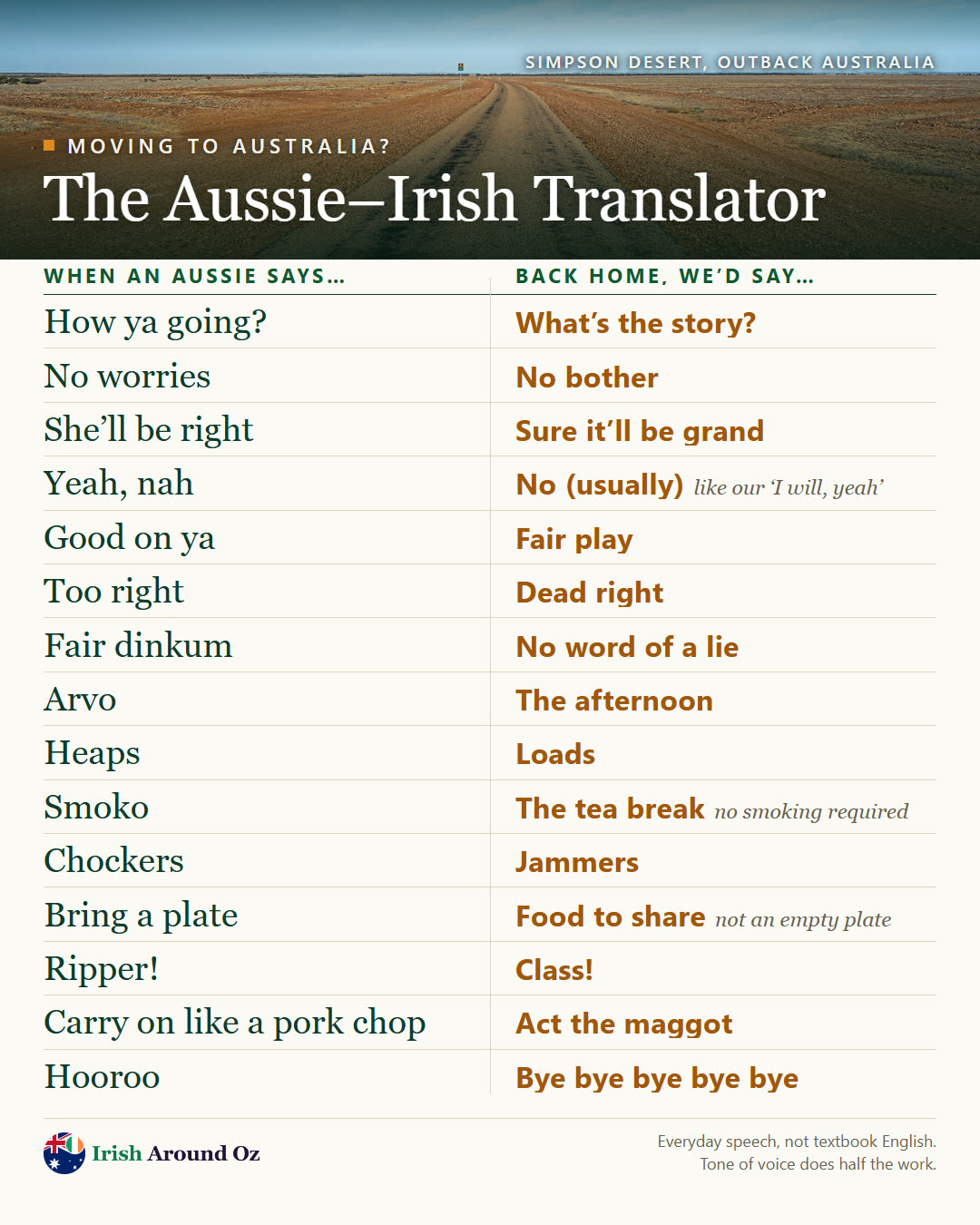
The Aussie-Irish translator: 29 phrases
The first 15 are the ones on the card, and the rest are the ones you’ll meet in your first few weeks. Every Aussie phrase here was checked in at least two sources, mostly the Australian National Dictionary Centre at ANU, Collins, Cambridge and Wiktionary. For the Irish side we used Wiktionary, Cambridge, The Irish Times and the Oxford English Dictionary’s 2025 update of Irish English words. It’s everyday speech, so expect the odd local twist.
| When an Aussie says… | Back home, we’d say… |
|---|---|
| How ya going? | What’s the story? |
| No worries | No bother |
| She’ll be right | Sure it’ll be grand |
| Yeah, nah | No (usually) like our “I will, yeah” |
| Good on ya | Fair play |
| Too right | Dead right |
| Fair dinkum | No word of a lie |
| Arvo | The afternoon |
| Heaps | Loads |
| Smoko | The tea break no smoking required |
| Chockers | Jammers |
| Bring a plate | Food to share not an empty plate |
| Ripper! | Class! |
| Carry on like a pork chop | Act the maggot |
| Hooroo | Bye bye bye bye bye |
| G’day | Hello at any hour, not just the daytime |
| I’m feeling crook | I’m sick or “I’ve a dose”, if it’s a cold |
| Rellies | The relations |
| Snag | A sausage |
| Chook | A chicken |
| I’ll shout you a coffee | The coffee’s on me |
| Stubby | A small bottle of beer |
| Tradie | A tradesperson |
| Hard yakka | Hard work the physical kind |
| Chuck a sickie | Call in sick when you’re not, strictly speaking |
| Fair go | A fair chance |
| Rego | The car registration and the fee you pay for it |
| Woop Woop | The middle of nowhere |
| Mozzie | A mosquito a midge with ambition |
Greetings and small talk
“How ya going?” is hello. It isn’t a real question about your health, so “Good thanks, you?” is the whole answer. It does the same job as “What’s the story?” at home, and nobody back home expects an actual story either.
G’day is short for good day, and you can say it at any hour. The Australian National Dictionary Centre traces it back to the 1880s and says it went global in the 1980s, when Paul Hogan invited the world to come over and say g’day in a run of tourism ads.
No worries might be the easiest translation on the list. The dictionary centre defines it as “no bother, no trouble”, which is word for word what we’d say.
If someone’s crook, they’re sick or injured (a crook knee is a bad knee), and the word can also just mean bad. Back home we’d say we have a dose, though a dose is usually a cold. And when a workmate asks about your rellies, they mean your relations.
Then there’s the goodbye. Hooroo means bye, and an Aussie who says it is usually already gone. The Irish version takes five byes, a “right so” and twenty minutes in the hall.
Food and drink
Bring a plate is the one that catches everyone. It means bring a plate of food to share: a salad, a dessert, a tray of something. The Australian National Dictionary Centre says there are many stories of new arrivals being bamboozled by it, and puts it plainly: “a plate alone will not do.”
Turn up with an empty one and you’ll still get a story out of the night. It just won’t be the one you wanted.
Tea is the evening meal, so “what’s for tea?” at six o’clock means dinner. Plenty of Irish homes say the same: Collins lists this meaning in British, Australian and New Zealand English, and Wiktionary lists Ireland too. One less thing to learn.
Brekkie is breakfast, and you probably say it already (Wiktionary lists it as Irish English as well as Commonwealth English). Nothing to translate there, just more avocado.
At the barbie, a snag is a sausage and a chook is a chicken. A barbie is a barbecue, which you knew. What you may not have known is that it can happen on Christmas Day.
BYO on a restaurant door means bring your own wine or beer. Collins lists BYO as Australian and New Zealand English for an unlicensed restaurant where diners can drink their own wine. Ask about a corkage charge when you book, so the bill doesn’t surprise you.
At work
Smoko is a short break from work. Collins says it’s for tea, a cigarette or the like, so you don’t have to smoke to take smoko. Nobody checks.
A tradie is a tradesperson: the electricians, plumbers, carpenters and the rest. If that’s you, our guide for Irish tradespeople moving to Australia has the next steps.
Hard yakka is hard work, the physical kind. The word has been around since the 1840s: the dictionary centre traces yakka to “yaga”, meaning work, in the Yagara language of the Brisbane region.
Chuck a sickie means take a day’s sick leave, often when you’re not really sick. The dictionary centre first records “sickie” in 1953, so your boss has heard the phrase. Not that you’d need it.
Still looking for somewhere to take smoko? Our guide on how to get a job in Australia starts from scratch.
Going out
If a workmate says “I’ll shout you a coffee”, they’re paying. Collins lists this sense of shout as Australian and New Zealand English: to treat someone to something, especially a drink. Wiktionary says the same and adds food and entertainment, so Aussies shout coffees, lunches and pints alike.
“It’s my shout” means it’s my turn to pay, which you’ll know from home as “my round”. You may hear “my shout” back home too. The rules of the round are the same in both countries, and the dictionary centre quotes a 1971 line that sums them up: when it comes to your turn, “return the shout”. Skip your turn and it’ll be remembered longer than your name.
A stubby is a small bottle of beer, especially a 375 ml one, says the dictionary centre, and a stubby holder is the insulated sleeve that keeps it cold.
A packed pub is chockers (jammers, at home), and a great night is a ripper, which we’d call class.
Getting around
Your car’s rego is its registration, and also the fee you pay for it. Buying one? Our guide to buying a car on a working holiday covers rego transfers state by state.
Woop Woop is any remote town in the middle of nowhere. It isn’t a real place: the dictionary centre calls it one of several made-up names Australians use for a typical outback town.
A mozzie is a mosquito. Pack the repellent: the midges at home were only practice.
Tone of voice: “yeah, nah” and “I will, yeah”
Half of Aussie slang is tone. “Yeah, nah” is usually a polite no: “Do you want a hand?” “Yeah, nah, I’ll be fine.” Linguist Kate Burridge points out it can also play down a compliment, or even mean an enthusiastic yes, so listen to the tone more than the words.
We have our own version. Said flat, “I will, yeah” means I will not, and Tourism Ireland translates it as “I absolutely will not”. So “yeah, nah” and “I will, yeah” usually end up in the same place. They just take different roads to get there.
“She’ll be right” means it’ll all work out, which is “sure it’ll be grand” with a tan. The dictionary centre notes that where others say “it’ll be right”, Australians say “she’ll be right”.
Fair dinkum means genuine, honest or true, our “no word of a lie”. Too right is dead right. Fair go means a fair chance, and “fair go!” on its own is a protest that something isn’t fair.
And if someone tells you to stop carrying on like a pork chop, you’re acting the maggot. The dictionary centre says it means to behave foolishly or make a fuss, so the translation holds up.
And the Irish words Aussies don’t get
It works both ways. Your Aussie flatmate will be just as lost when you tell them the towels are in the hot press. Our guide to the Irish words Australians don’t understand covers grand, giving out, the craic and plenty more, so you can explain yourself.
Settling in
The lingo comes quicker than you’d think. For everything else, the complete guide to moving to Australia from Ireland covers visas, jobs and money, and our moving to Australia checklist has a first week section, from your tax file number to your bank account.
Which Aussie phrase threw you the first time you heard it? Tell us in your local group. Our Irish groups around Australia are the place to ask, and there’s always someone who got there before you.
FAQ
What does “bring a plate” mean in Australia?
It means bring a plate of food to share, such as a salad, a dessert or finger food. It doesn’t mean bring an empty plate. You’ll see it on invitations to parties, barbies and fundraisers.
What is smoko in Australia?
Smoko is a short break from work, for a cup of tea, a cigarette or the like. You don’t have to smoke to take one. It’s Australian and New Zealand English, and the Irish equivalent is the tea break.
What does “shout” mean in Australia?
To shout someone is to treat them, as in “I’ll shout you a coffee”. “It’s my shout” means it’s my turn to pay, the same as “it’s my round” at home.
What does “how ya going” mean?
It’s a greeting, the Australian way of saying “how are you doing?”. Answer “Good thanks, you?” and keep going. The Irish equivalent is “What’s the story?”.
What does “she’ll be right” mean?
It means everything will be fine and there’s no need to worry. It’s the Australian version of “sure it’ll be grand”.
What does fair dinkum mean?
Fair dinkum means genuine, honest or true. Back home we’d say “no word of a lie”.
What is a tradie in Australia?
A tradie is a tradesperson, such as an electrician, plumber or carpenter. Collins lists it as informal Australian English.
What does “chuck a sickie” mean?
To chuck a sickie is to take a day off sick, usually when you aren’t really sick. The Australian National Dictionary Centre first records “sickie” in 1953.