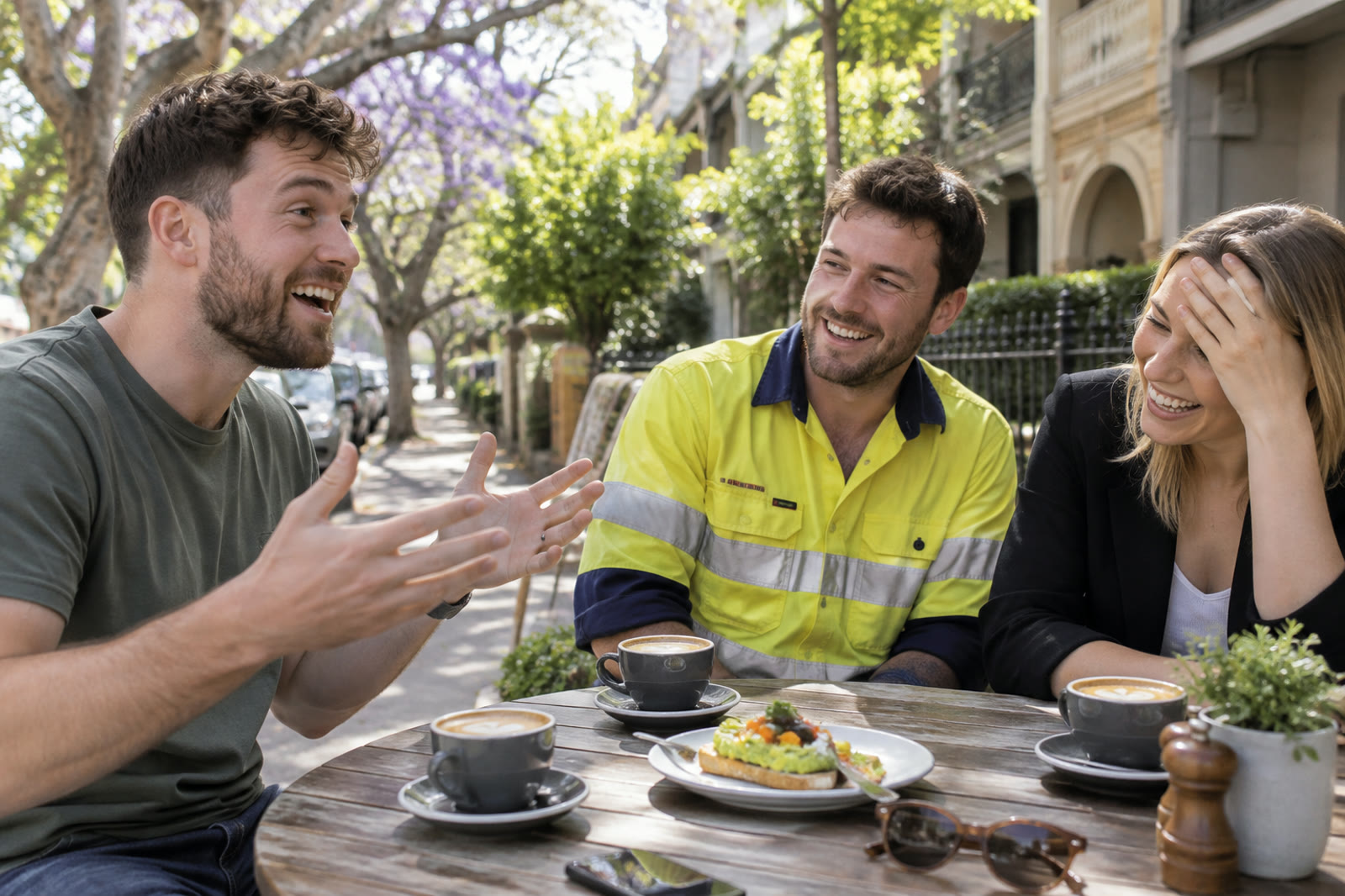
The Irish words Australians struggle with most are the everyday ones: hot press (the airing cupboard), giving out (complaining), grand (fine, not fancy), the messages (the grocery shopping) and craic (fun, or the news). It works both ways, mind: arvo, servo and thongs will have you nodding along blankly for your first few weeks. Below are 30 of ours, 15 of theirs, and what they all actually mean.
We’ve all had the moment. You say something completely normal at work and the whole smoko table goes quiet. This is the cheat sheet. The meanings are checked against the Cambridge, Collins, Oxford and Merriam-Webster dictionaries, the Australian National Dictionary Centre at ANU, The Irish Times, the Irish Post, RTÉ and Tourism Ireland. The jokes are all ours.
Short version
- Hot press: the airing cupboard where clean towels finish drying. Not a newspaper, not a sandwich toaster.
- Giving out: complaining or telling someone off. Nothing is being handed out.
- Grand: fine, OK. “I’m grand” is not a boast.
- The messages: the grocery shopping, not your texts.
- I will, yeah: means “I absolutely will not”. It’s all in the tone.
Irish words around the house
Moving into a share house? These are the ones that cause trouble in the first week.
| Irish word | What it means (and the Aussie confusion) |
|---|---|
| Hot press | The airing cupboard: the heated cupboard where washed towels and sheets finish drying. Collins lists it as the Irish name for one. In Australia: ask your housemate to put the towels in the hot press and they come back holding the sandwich press. |
| Press | A cupboard, usually the kitchen one. “The mugs are in the press.” In Australia: they go looking for a bench press. |
| The messages | The grocery shopping, as in “I’m going for the messages”. In Australia: tell your boss you’re nipping out for the messages and they assume you’re checking your phone. |
| Minerals | Fizzy soft drinks. The Oxford English Dictionary added this Irish meaning in 2025. In Australia: offer “minerals for the kids” at a barbie and someone hands you a multivitamin. |
| The jacks | The toilet. It comes from “jakes”, an old English slang word for a toilet. In Australia: “Where’s the jacks?” gets you “Jack who?” |
| Gaff | Your house or flat. “Back to my gaff after?” In Australia: it sounds like an invitation to an embarrassing mistake. |
| Yoke | Any thing whose name you can’t think of right now. “Pass us that yoke there.” In Australia: your workmate hands you an egg. |
Looking for Hot Press the magazine? That’s a different hot press entirely: Ireland’s music and pop culture magazine, over at hotpress.com. The one in this guide just keeps your towels warm.
Irish words for describing people
Most of these are compliments. The trick is knowing which ones.
| Irish word | What it means (and the Aussie confusion) |
|---|---|
| Grand | Fine, OK. Not magnificent. “How was the date?” “Grand.” means it was fine, nothing more. In Australia: they hear either “fancy” or “a thousand dollars”. |
| Eejit | An idiot, usually said with a bit of affection. In Australia: the local version is “drongo”, which the Australian National Dictionary Centre defines as a fool or a simpleton. |
| Gas | Hilarious, great fun. “Your sister is gas.” In Australia: they wonder what she had for lunch. |
| Sound | Decent, reliable, a good person. “He’s sound.” In Australia: they wait politely for the rest of the sentence. |
| Notions | Ideas above your station. “The notions on him!” is not a compliment. In Australia: having notions sounds like having ideas, which sounds like a good thing. |
| Bold | Naughty, as in “Don’t be bold!” In Australia: tell a parent their toddler was very bold and they beam with pride. |
| Delira | Delighted, thrilled to bits. In Australia: “I’m delira” sounds close enough to “delirious” that someone fetches you a glass of water. |
| Banjaxed | Broken beyond repair. People can be banjaxed too, after a big night. Merriam-Webster says nobody knows where the word comes from. In Australia: your property manager still just wants to know what’s broken. |
| Morto (or scarlet) | Mortified, completely embarrassed. Morto made the Oxford English Dictionary in 2025. In Australia: “I was scarlet” just sounds like you forgot the suncream. |
| Your man / your one | That man or that woman, when you don’t know or can’t remember the name. “Your one from accounts rang.” In Australia: tell a colleague “your man in IT sorted it” and she wonders how you know her husband. |
| Class | Excellent, brilliant. The OED added this one in 2025, quoting Derry Girls. In Australia: “That gig was class” gets “Which class? Year 10?” |
| Savage | Fantastic. “That match was savage.” In Australia: it sounds like somebody got mauled. |
Everyday Irish chat that loses Australians
A lot of Irish English comes straight from the Irish language, which is why some of it sounds back to front to everyone else.
| Irish phrase | What it means (and the Aussie confusion) |
|---|---|
| Craic | Fun, news or gossip. “What’s the craic?” means what’s happening. It’s the old Scots and northern English word “crack”, given an Irish spelling in the 20th century. In Australia: it has nothing to do with the illegal stuff, whatever your manager’s face says. |
| Giving out | Complaining, or telling someone off: “Mam’s giving out about the phone bill.” It’s a straight translation of the Irish “tabhair amach”. In Australia: they ask what’s being given out and whether there’s any left. |
| What’s the story? | How are you? Often shortened to just “Story?” In Australia: they settle in for a long anecdote. |
| C’mere (come here to me) | “Listen to this”, even when you’re standing right beside them. In Australia: they take a step closer, then look worried. |
| I’m after (doing something) | I’ve just done it. “I’m after eating my lunch.” It mirrors the Irish “tar éis”. In Australia: they wonder why you’re chasing your lunch. |
| Fair play (to you) | Well done. In Australia: the local phrase is “fair go”, which means a fair chance or a fair deal, so they think you’re settling an argument. |
| Lash | Does three jobs: “give it a lash” (have a go), “it’s lashing” (pouring rain) and “on the lash” (out drinking). In Australia: they can’t tell if they’re being invited out or threatened. |
| Ye | “You”, usually when you’re talking to more than one person. “Are ye coming?” In Australia: they feel like they’ve wandered into a Shakespeare play. |
| Up to 90 | Stressed out and run off your feet. In Australia: they assume it’s a speed limit. |
Two Irish phrases that mean the opposite of what they say
These are the dangerous ones, because Australians take them literally.
“I will, yeah”
Said flat and sarcastic, it means the exact opposite. Tourism Ireland’s own translation is “I absolutely will not”. Say it to your Aussie boss when they ask who’s free to work Sunday and you may well find your name on the Sunday roster.
“Ah, would you go away!”
Not a request to leave. It means “oh wow, really?”, the thing you say when you’re shocked or can’t quite believe what you’re hearing. Say it to an Aussie halfway through their story and they might actually go.
New job? Translate as you go. For the first few weeks, “I’m grand” becomes “I’m good, thanks”, “giving out” becomes “complaining” and “the jacks” becomes “the toilet”. Give it a few months and you’ll be saying arvo without noticing, and your mates at home will be giving out about it.
Aussie words that confuse the Irish
Fair’s fair: Australian English throws plenty back at us. A lot of it is the Aussie habit of shortening a word and sticking an “o” on the end, which the Australian National Dictionary Centre calls a special feature of Australian English. And they’ve borrowed from us too: the centre says “sheila” first appeared here in 1832, used at first for a woman of Irish origin.
| Aussie word | What it means |
|---|---|
| Arvo | Afternoon. “See you Saturday arvo.” First recorded in the 1920s and still going strong. |
| Servo | A petrol station (service station). Nothing to do with robots. |
| Bottle-o | The off-licence, short for bottle shop. |
| Thongs | Flip-flops. At home a thong is underwear, so “bring your thongs to the beach” takes a second to process. |
| Esky | A cool box for drinks and food. It started out as a brand name and now turns up at every barbie. |
| Ute | A pickup with a car-style cab and a tray on the back. Short for utility, first recorded in 1943. |
| Togs, bathers, swimmers, cossie | Swimwear, and the word depends on the state: togs in Queensland, bathers in Victoria and WA, swimmers or cossies in NSW. Collins lists togs as Irish too, so Brisbane will feel like home. |
| Sanger | A sandwich. Australians were saying “sango” in the 1940s before sanger took over. |
| Trackie daks | Tracksuit bottoms. Daks started out as a brand of trousers. |
| Budgie smugglers | Tight men’s swimming briefs. You’ll know them when you see them. |
| Smoko | A short break at work, for a cuppa or a cigarette. You don’t have to smoke to take smoko. |
| Durry | A cigarette. |
| No worries | No bother, no trouble, it’s all fine. First recorded in the 1960s, and you’ll be saying it by week two. |
| Yeah nah | Usually a polite no: “Do you want a hand?” “Yeah nah, I’ll be fine.” But depending on the tone it can also play down a compliment, or even mean yes. |
| Maccas | McDonald’s. The nickname is so well known that McDonald’s put “Macca’s” on the signs of 13 Australian stores around Australia Day 2013. |
One word that works in both countries: deadly. At home it means great, and The Irish Times notes that Aboriginal people in Australia use it the same way. Just don’t mix it up with the other Aussie kind of deadly, the one with fangs.
Settling in
The lingo is only one of the surprises. Our 10 little-known things that happen when you move to Australia covers the rest of the culture shock, and the complete guide to moving to Australia from Ireland handles the practical side, from visas to your tax file number and bank account. And when a workmate warns you about drop bears with a dead straight face, read up on the drop bear wind-up first. Just landed in Sydney? The guide to the Irish in Sydney points you to the pubs, GAA clubs and people who already know what a hot press is.
Which one have you had to explain at work? Tell us in the group. Our Irish groups around Australia are full of people who’ve had to explain “giving out” to a confused manager, and there are plenty more words we didn’t fit in here.
FAQ
What is a hot press in Ireland?
A hot press is the Irish name for an airing cupboard: a heated cupboard where washed towels, sheets and clothes finish drying. It’s not to be confused with Hot Press, the Irish music and pop culture magazine.
What does craic mean?
Craic means fun, a good time, or news and gossip. “What’s the craic?” is a greeting that means “what’s going on?”. It comes from the Scots and northern English word “crack”, spelled the Irish way.
What does “giving out” mean in Ireland?
Giving out means complaining or telling someone off, as in “she was giving out about the traffic”. It comes from the Irish phrase “tabhair amach”.
What does “grand” mean in Ireland?
In Ireland “grand” usually means fine or OK. “I’m grand” means “I’m fine, thanks”, not “I’m doing brilliantly”.
What does arvo mean in Australia?
Arvo means afternoon, as in “see you this arvo”. It’s one of many Australian words made by shortening a word and adding an “o”, and it was first recorded in the 1920s.
What does “yeah nah” mean in Australia?
Most of the time it’s a polite, softened no. Linguists point out it can also play down a compliment or even show strong agreement, so listen to the tone.